
What makes a good puzzle cut

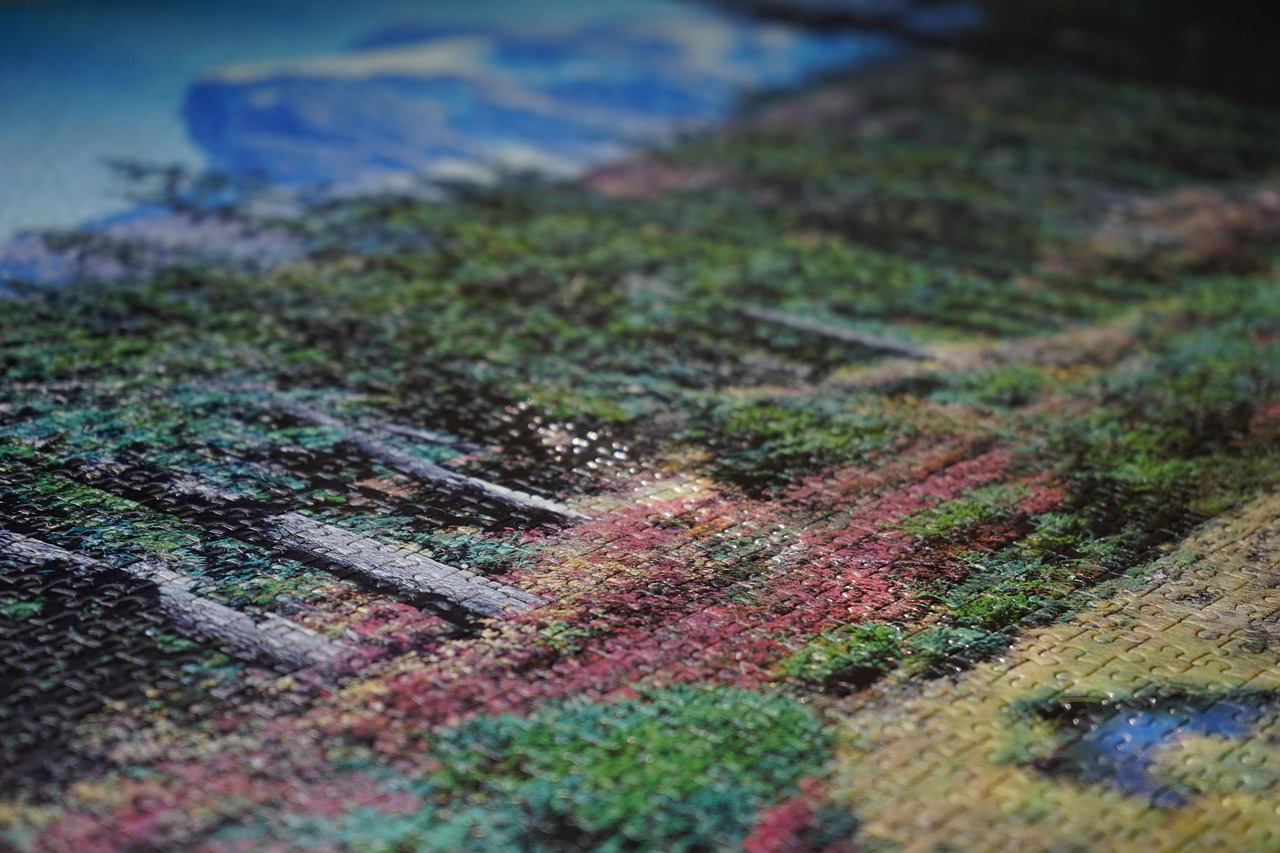
What makes a good puzzle cut
Puzzle quality is almost entirely invisible on a shelf and completely obvious ten minutes into a build. Two boxes with the same image and the same piece count can produce very different evenings, and the difference is in the board and the die rather than in the picture.
Here is what actually varies, and what you can check.
Board thickness
Thicker board holds its shape, resists bending when a section is lifted and gives pieces a satisfying weight. Thin board bows, and a bowed piece will not sit flush with its neighbours, which makes a finished area look uneven.
You can feel this immediately by handling a single piece. It is the most reliable quality signal available.
Fit, and what “snap” means
A good cut gives a positive engagement — a slight resistance and then a seat. Too loose and assembled sections fall apart when nudged; too tight and pieces have to be forced, which damages the tabs.
The practical consequence of a loose cut is that you cannot move a section, which matters enormously if you are building on a board.
Die sharpness
Puzzles are cut with a steel die that dulls over a print run. A sharp die gives clean edges; a dull one leaves fuzzy, compressed edges and a lot of paper dust in the box.
Dust in the box is the visible symptom, and it is worth noticing when you open one.
Layer separation
Puzzle board is a printed layer laminated to a backing. Poor lamination shows as the print lifting at the edge of a piece, particularly after a puzzle has been built more than once.
This is the most common failure in a puzzle that is kept and rebuilt, and it is not repairable.
Cut pattern and repetition
Traditional grid cuts produce a limited number of piece shapes, which makes large single-colour areas solvable by shape. Random or ribbon cuts produce more variety, which is more interesting to look at and considerably harder in a plain region.
Neither is better; they suit different tolerances for frustration.
False fits
A cut with few distinct shapes will let a wrong piece sit convincingly in a gap. That is the source of most late-stage puzzle problems, where a region will not close and the error is thirty pieces away.
Better cuts vary the tab geometry enough that a wrong piece feels wrong immediately.
Surface finish
Matte and linen finishes scatter light and are far easier to work under an evening lamp. Gloss looks better in a photograph and produces reflections that hide the detail you are matching.
Where the maker states a finish, it is on our listings.
Print registration
If the print is very slightly misaligned with the cut, the image will not run continuously across a joint. It is subtle and it is the sort of thing you notice on a finished puzzle and cannot then unsee.
This is rare on established ranges and common on very cheap ones.
Piece count accuracy
A “1000-piece” puzzle is often 1008 or 1026, because the cut has to make a rectangle. That is entirely normal and is not a defect. What is worth checking is that the box states the true count somewhere, since it tells you the maker is being precise.
A missing piece is far more likely to be under the table than absent from the box.
The poster
An included full-size or near-full-size poster is a genuine quality indicator, because it costs money and only serious ranges bother. It is also the most useful accessory in the box.
Ranges that omit it usually print the image small on the back, which is much less useful.
Wooden puzzles are a different animal
Laser or scroll-cut wooden puzzles have no board at all, hold together far more firmly, and often include whimsy pieces cut into shapes. They cost considerably more, they last effectively forever, and they behave differently enough that piece-count comparisons do not transfer.
They are worth trying once if you build regularly.
What we check before stocking
Board thickness by hand, fit by assembling a few pieces, and dust by opening the bag. Those three take a minute and catch nearly everything. What we do not do is rank puzzles by score or repeat marketing claims about difficulty.
The range is on the shop page, with the wooden options under wooden puzzles, and the counter can be asked directly on the number on the contact page.
Why the same image costs three different prices
Walk along a puzzle shelf and you will find near-identical images at noticeably different prices, which looks like branding and mostly is not. The cost sits in the board — thickness, lamination quality and the consistency of the print layer — and in how far into its life the cutting die was when your particular box was made. None of that is visible through shrink wrap, which is precisely why it is where manufacturers economise.
The practical consequence is that a cheap puzzle is not a smaller version of an expensive one; it is a different experience of the same picture. Thin board means sections cannot be lifted, a dull die means dust and fuzzy edges, and weak lamination means the print lifts if the puzzle is ever built twice. For a puzzle that will be built once and given away, none of that matters much. For one you intend to keep, rebuild or frame, it is the whole of the decision.