
Sorting strategies that actually work

Sorting strategies that actually work
Most people sort a puzzle the way they were taught as children: turn everything face up, find the edges, build the frame. That is a good start and it is roughly a fifth of the available technique. The rest is what separates a 1000-piece puzzle that takes six evenings from one that takes twelve.
None of it is complicated, and all of it is worth doing before assembling anything.
Turn everything face up first, without exception
It is tedious and it is not optional. Every piece left face down is a piece you will pick up, turn, reject and put back several times. Doing it all at once, before anything else, is the single largest time saving available.
Do it in the box lid in batches rather than on the table, so you are not working around a pile.
Edges, and the pieces that look like edges
Separate the straight-edged pieces as you turn. Watch for pieces with one straight side that are not edges — some cuts produce them in the interior, and a frame that will not close is usually one of those.
Count your edges against the expected number where the box gives dimensions; it is a useful early check.
Sort by colour region, not by colour
The useful groups are not “blue” and “green” but “sky”, “water” and “foliage”, because those are the areas of the image you will work on as units. A piece that is half sky and half roof belongs with the roof group, not with the sky.
Boundary pieces are the most valuable in the whole puzzle and deserve their own tray.
Sort by cut shape for large single-colour areas
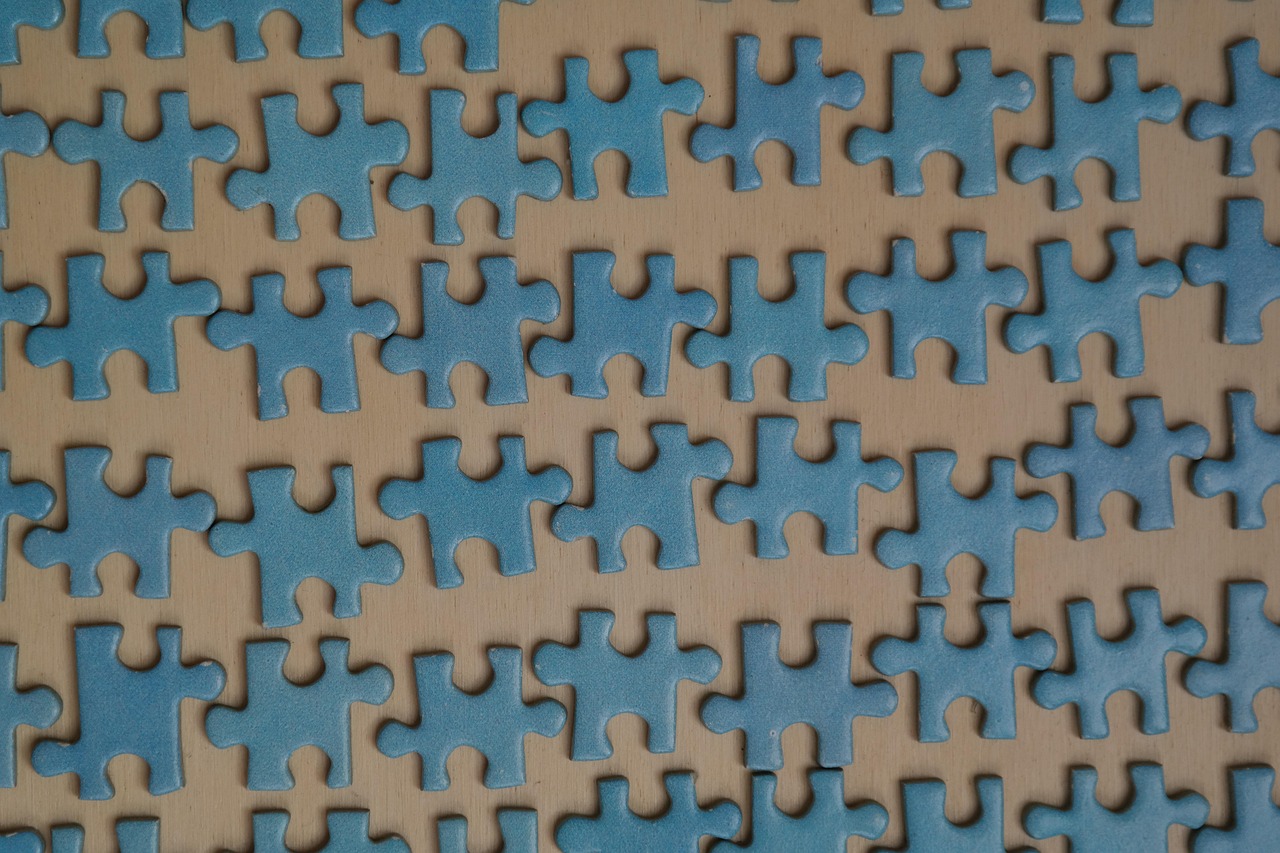
When you reach a large sky or a plain background, colour stops distinguishing anything and shape is all that is left. Most puzzles use a small number of repeating piece shapes — two tabs and two blanks, three and one, and so on — and sorting a difficult region by shape turns an impossible area into a manageable one.
This is the technique that rescues the last two hundred pieces of a landscape.
Sort by texture and line
Pieces carrying a straight line — a window frame, a horizon, a fence, a road edge — are worth pulling out as a group regardless of colour. Lines assemble quickly and give you anchors across the middle of the puzzle, which is where progress usually stalls.
The same applies to text, which is the fastest-assembling thing in any image.
Use the poster, properly
Prop the reference image upright rather than laying it flat, and look at it at the same orientation as the puzzle. Most puzzles include a poster for exactly this and most people leave it in the box.
For a difficult area, hold a piece up against the poster rather than searching the table.
Build from the inside as well as the edge
The frame-then-inward method leaves the hardest region for last. Building distinct interior objects as separate islands and joining them later spreads the difficulty out and gives you a sense of progress much earlier.
It also means you are always working on something that is going well.
Keep sorted piles small
A tray with two hundred pieces in it is not sorted; it is a smaller box. If a group is too large to scan in one look, split it again — by shade, by shape, by whether the piece has a line on it.
Four to five groups of forty is far more useful than two groups of a hundred.
Work in sessions with a plan
Deciding what you will work on before you sit down — the frame, the building, the sky by shape — is more productive than picking up whatever is nearest. It also means a twenty-minute session achieves something rather than being spent re-scanning the same pile.
Leave the puzzle mid-region rather than mid-search; it is much easier to resume.
Two people, two areas
Working with somebody else is only faster if you divide the image rather than both searching the same pile. Agree who has which region, keep separate sorted trays, and swap boundary pieces as you find them.
Both people sorting the same tray is slower than one person doing it.
When to stop sorting and start building
Sorting has diminishing returns. Once the edges, the boundary pieces and two or three clear regions are separated, further sorting is usually procrastination. Start building, and sort further only when a region stalls.
The exception is a very large single-colour area, which is worth sorting by shape before you reach it.
Where to look
Trays and boards are on the wooden puzzles and 1000 piece puzzles shelves. For images with a clear structure to sort by, landscape and national park puzzles is the friendliest starting point.
There is more on surfaces in where to build a puzzle, and the counter is on the number on the contact page.